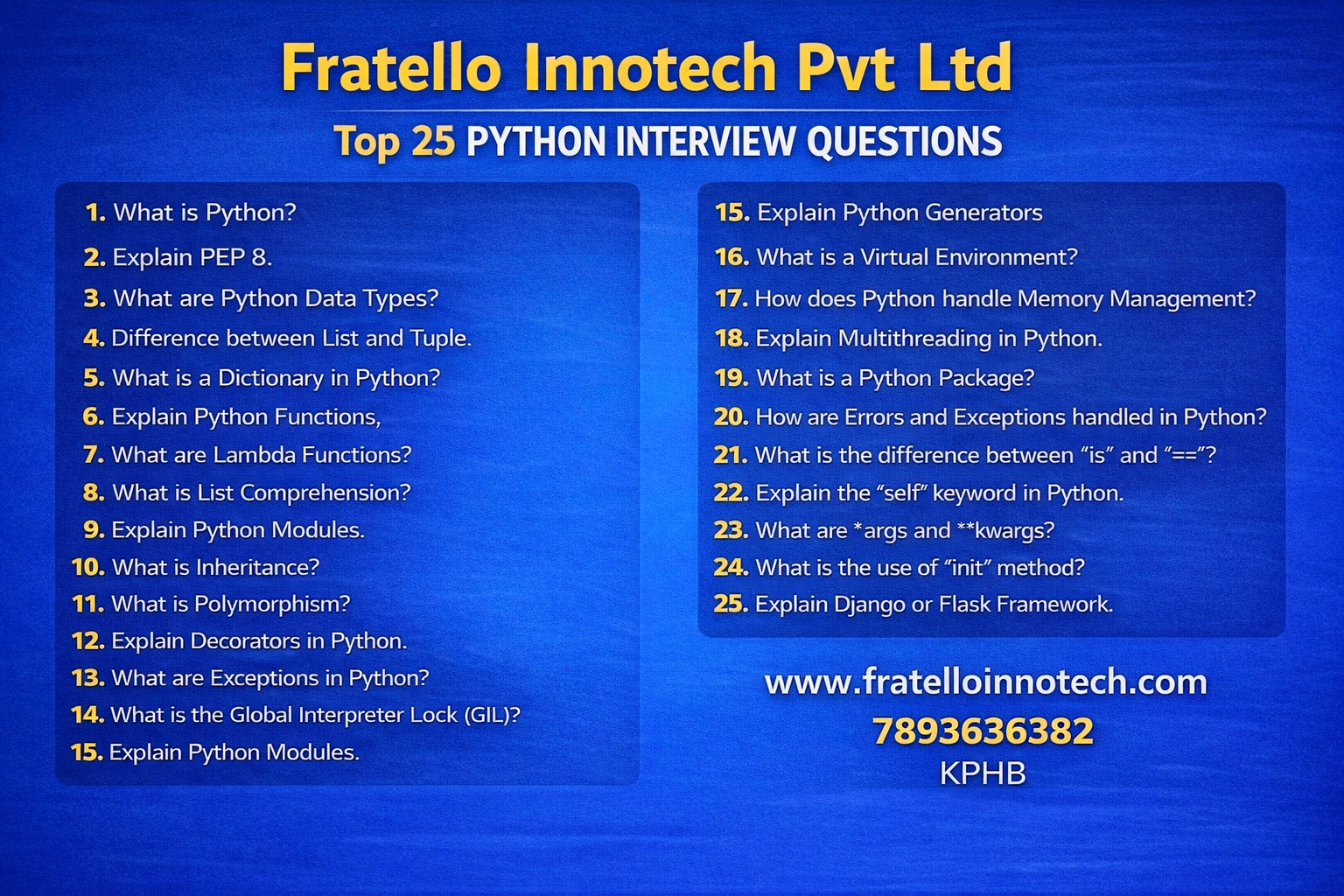
Top 25 Python Interview Questions
If you are preparing for a Python interview, it’s important to have a strong understanding of both basic and advanced concepts. In this blog, we cover the Top 25 Python Interview Questions that are commonly asked in interviews to help you crack your next opportunity.
1. What is Python?
Python is a high-level, interpreted programming language known for its simplicity and readability. It is widely used in web development, data science, automation, and more.
2. Explain PEP 8
PEP 8 is the official style guide for Python code. It provides conventions for writing clean and readable code.
3. What are Python Data Types?
Common data types include int, float, str, list, tuple, dict, and set.
4. Difference between List and Tuple
List is mutable (can be changed), while Tuple is immutable (cannot be changed).
5. What is a Dictionary in Python?
A dictionary stores data in key-value pairs.
6. Explain Python Functions
Functions are reusable blocks of code used to perform a specific task.
7. What are Lambda Functions?
Lambda functions are small anonymous functions defined using the lambda keyword.
8. What is List Comprehension?
List comprehension is a concise way to create lists using a single line of code.
9. Explain Python Modules
Modules are files containing Python code that can be imported and reused.
10. What is Inheritance?
Inheritance is a concept where one class inherits properties and methods from another class.
11. What is Polymorphism?
Polymorphism is the ability of a function or object to take multiple forms.
12. Explain Decorators in Python
Decorators modify the behavior of functions without changing their actual code.
13. What are Exceptions in Python?
Exceptions are errors that occur during program execution.
14. What is GIL (Global Interpreter Lock)?
GIL is a mechanism that ensures only one thread executes Python bytecode at a time.
15. Explain Python Generators
Generators are functions that return an iterator using the yield keyword.
16. What is a Virtual Environment?
A virtual environment is an isolated environment to manage dependencies.
17. How does Python handle Memory Management?
Python uses automatic memory management with garbage collection.
18. Explain Multithreading in Python
Multithreading allows running multiple threads simultaneously, but is limited by GIL.
19. What is a Python Package?
A Python package is a collection of modules organized in directories.
20. How are Errors and Exceptions handled?
They are handled using try, except, finally, and else blocks.
21. Difference between is and ==
“is” checks identity, while “==” checks value equality.
22. Explain the self keyword
The self keyword refers to the current instance of a class.
23. What are *args and **kwargs?
*args is used for variable positional arguments and **kwargs is used for variable keyword arguments.
24. Use of __init__ method
The __init__ method is a constructor used to initialize objects.
25. Explain Django or Flask
Django is a full-stack framework, while Flask is a lightweight framework.
Conclusion
Preparing these questions will give you a strong foundation in Python and boost your confidence in interviews. Practice regularly and focus on understanding concepts rather than memorizing answers.